Conquering "Pickleball Elbow": Biomechanics, Paddle Mechanics, and Evidence-Based Tendon Loading

Conquering "Pickleball Elbow": Biomechanics, Paddle Mechanics, and Evidence-Based Tendon Loading
If you’ve spent any time around the local courts in Vancouver, you know the sound of a well-struck composite paddle—and you’ve likely heard someone grumbling about a nagging, burning ache on the outside of their elbow.
Commonly referred to as "pickleball elbow," lateral epicondylalgia is the single most frequent overuse injury seen in recreational and competitive court athletes. While traditionally associated with tennis, the rapid hand exchanges, high stroke volume, and paddle dynamics of pickleball create a unique mechanical environment for your forearm extensor tendons.
Let’s look at what the current clinical evidence tells us about why this happens, how paddle specs influence tissue stress, and how to build resilient tendons that keep you playing pain-free.
1. It’s a Tendinopathy, Not "Tendonitis"
For decades, elbow pain was treated as an acute inflammatory problem ("lateral epicondylitis"). Modern tendon histopathology demonstrates that chronic tendon pain is actually a tendinopathy, a failed healing response characterized by collagen disorganization, hypervascularity, and cell proliferation, most commonly at the common extensor origin, specifically the extensor carpi radialis brevis, or ECRB.
Because the issue is degenerative collagen overload rather than acute chemical inflammation, prolonged rest and ice packs rarely fix the root problem. Tendons require progressive mechanical load to stimulate collagen remodeling and restore load tolerance.
2. On-Court Biomechanical Culprits
Pickleball elbow rarely develops in isolation; it is almost always the result of a rapid spike in playing volume combined with repetitive mechanical breakdown:
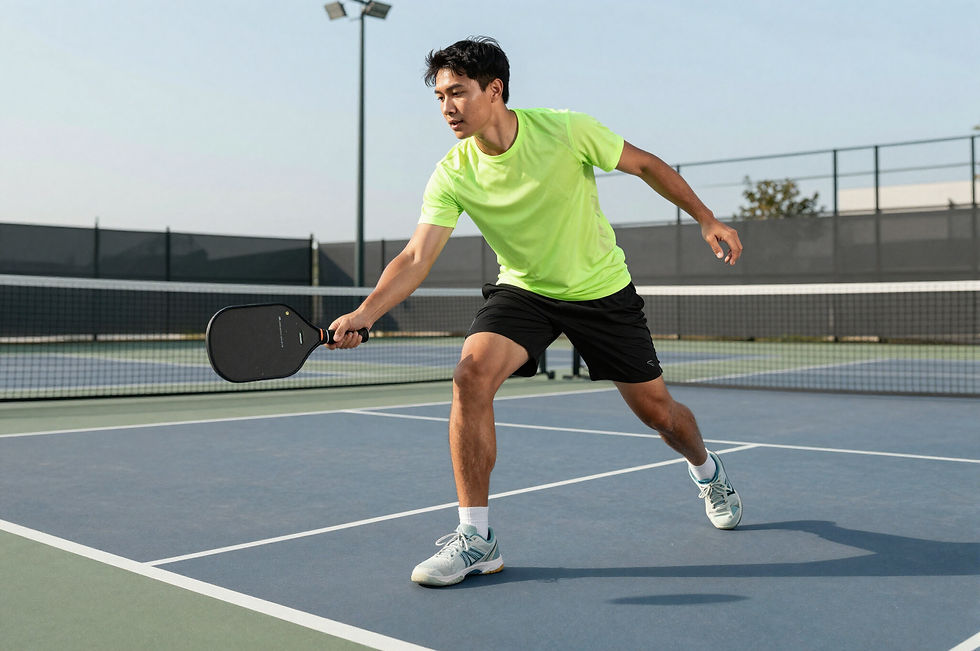
Leading with the Elbow on Backhand Dinks: Flicking the wrist or leading with a bent elbow during backhand resets forces the wrist extensors to contract eccentrically against paddle impact, driving excessive tensile strain straight into the lateral epicondyle.
The Death Grip: Gripping the paddle with maximum force throughout the entire point elevates baseline muscle tone in the forearm, preventing active muscle relaxation between contacts.
Late Ball Contact: Hitting the ball behind your lead hip forces the wrist into awkward extension and radial deviation to compensate, transferring shock directly to the elbow rather than distributing it across the torso and legs.
3. Paddle Physics: Weight, Twist Weight, and Core Thickness
Your paddle is the mechanical link between the ball and your arm. Subtle equipment modifications can dramatically reduce peak shock transmission:
Swing Weight vs. Static Weight: While a lighter paddle feels nimble for quick hand battles at the kitchen, an ultra-light paddle often lacks torsional stability. Off-center hits twist the paddle in your hand, forcing your forearm muscles to clamp down harder to resist torque. Adding tungsten tape to the 3 and 9 o’clock perimeter can increase the sweet spot and minimize twisting.
Core Thickness, 16mm vs. 13mm/14mm: Thicker honeycomb polypropylene cores, typically 16mm, absorb impact vibration more effectively than thinner power paddles, decreasing the vibration frequency transmitted up the kinetic chain.
Grip Size: A grip that is too small forces excessive finger flexion and wrist co-contraction. If your fingers wrap completely around and touch the base of your thumb, consider adding an overgrip to optimize hand contact and reduce forearm strain.

4. Evidence-Based Rehabilitation Protocols
Restoring tendon capacity requires structured, progressive resistance training. Incorporate these three phases into your routine:
Phase 1: Isometric Wrist Extension Holds (Pain Modulation)
Goal: Downregulate cortical inhibition and reduce resting tendon pain. Execution: Sit with your forearm supported on a table, holding a light dumbbell, 2 to 5 lbs, with your wrist extended to roughly 30 degrees. Hold this position statically without movement. Dose: 5 sets of 45-second holds, resting 2 minutes between sets.
Phase 2: Heavy Slow Resistance and Eccentric Loading
Goal: Promote collagen realignment and tensile strength. Execution: Using a resistance bar, such as the Tyler Twist technique with a flexible rubber bar, or a dumbbell, lift the weight with assistance, then slowly lower the wrist through flexion over a controlled 3-to-4-second count. Dose: 3 sets of 10 to 12 repetitions, performed every other day.
Phase 3: Kinetic Chain and Scapular Strengthening
Goal: Offload distal arm joints by generating power from the hips, trunk, and scapular stabilizers. Key exercises: Prone Y-T-W raises, serratus wall slides, and cable trunk rotations.
Ready to Get Back on the Court?
Navigating chronic tendon pain doesn’t mean hanging up your paddle for months. With an individualized assessment of your stroke mechanics, equipment tuning, and a targeted loading progression, you can resolve elbow pain and return to peak court form.

If you’re dealing with stubborn elbow or shoulder pain in Vancouver, book a comprehensive court-sport assessment with Cameron Wong, DPT at Strength Through Motion today.
Cameron Wong, DPT. Physiotherapist and Clinic Manager. Strength Through Motion, Vancouver, BC.
camwongphysio.ca
Comments